An Intentional Piece – Social-Emotional Ethical Learning
By Mamta Motwani A humanistic educator Reflecting back on my experiences with children as an educator in the past 20 years, I can confidently say that I have supported the holistic well-being of my studen
By Mamta Motwani
A humanistic educator
Reflecting back on my experiences with children as an educator in the past 20 years, I can confidently say that I have supported the holistic well-being of my students. Until two years back, I did so intentionally without knowing that it was called SEL, Social Emotional Learning. The roots of SEL go back to Ancient Greece when Plato proposed a holistic curriculum in his article to The Republic. Schools often speak of Holistic Development. However, SEL could still be called The Missing Piece in some schools, because it is not yet an intentional part of the curriculum like Math, Science, or English.
Taking SEL one step further, we now have SEE Learning, a term given by Emory University in collaboration with the Buddhist spiritual leader, Dalai Lama.
SEE Learning that is Social Emotional and Ethical Learning is a term used for the skills and strategies that are taught to the children to foster their enduring capabilities. It is a program to develop mental strength, trauma and resiliency skills, compassion, attention training, and ethics.
I personally believe that no matter how good the lesson plan maybe, but if the children are not emotionally and socially happy as well as ethically strong, the process of teaching and learning will not be a success.
Change is constant in our lives as well as those of our children, is also difficult. It pushes us out of our comfort zones. Today, change is not just constant but also rapid. To deal with change we need skills and capabilities. We need to be taught strategies to not just build those skills but use and transfer those skills in new situations throughout our lives. These skills need to be fostered from a very young age.
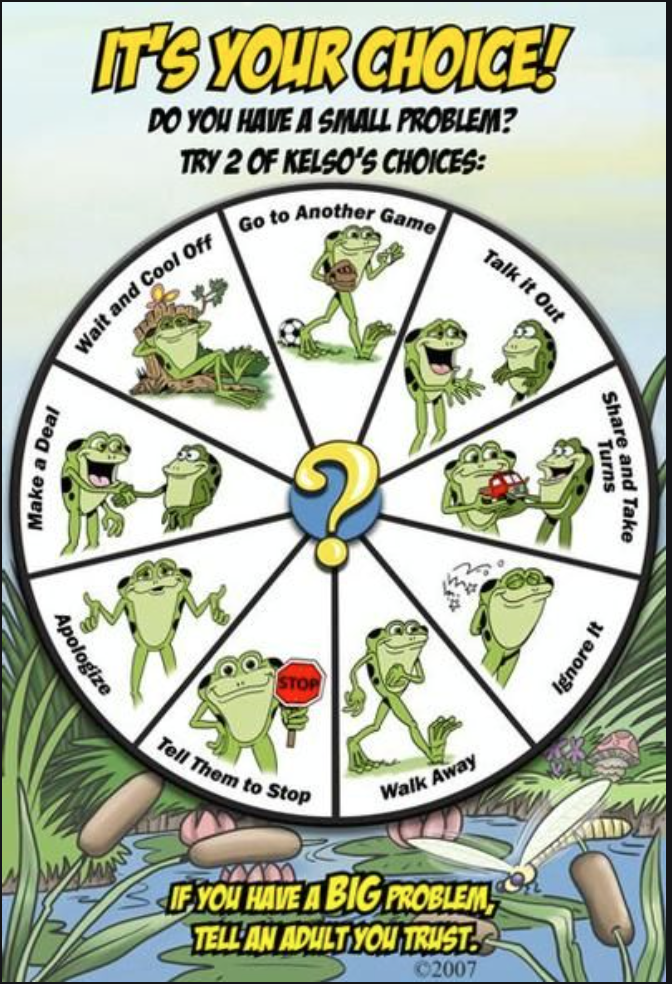
Let us explore some situations. Taking the example of a playground, teaching students The Kelso’s Choice enables them to learn conflict management skills and gives them concrete tools to deal with conflict in a positive way. Interactive Modeling by the teacher and the classmates, role play, and dramatization can be incorporated in the class to generate situations of conflict and practice the strategies to manage the conflicts.
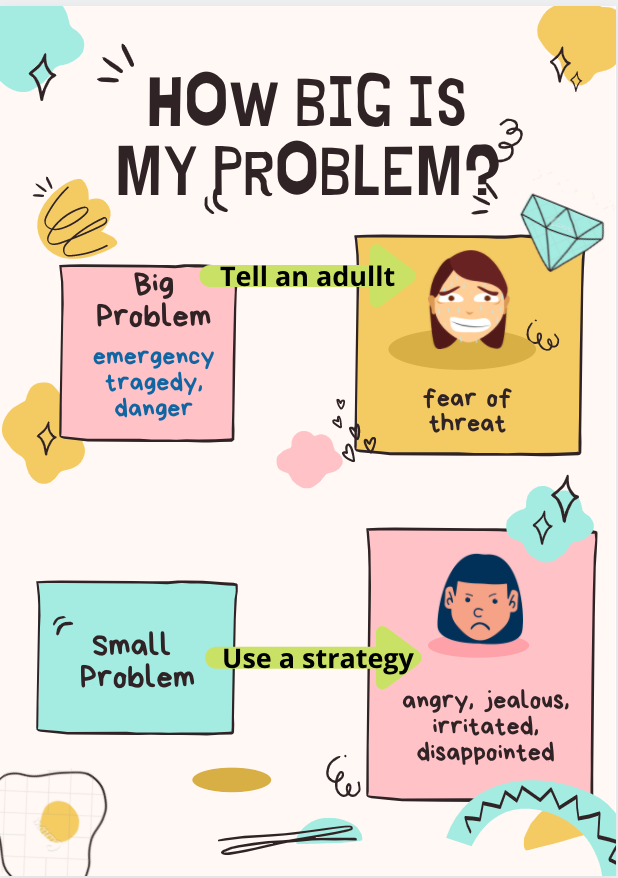
Speaking about big and small problems. Our problems create feelings which in turn bring out reactions. Can children or adults distinguish between small and big problems? Do feelings tell us about how big or small a problem is? Identifying if a problem is big or small can help us manage our emotions and in turn our reactions. It is imperative to teach our children that big emotions need not necessarily imply a big problem. A big problem needs to be taken to an adult whereas a small problem can be solved by the children.
So which emotions imply a big problem? Emotions of being afraid, distrust, fear of threat, pain imply a big problem that needs an adult to know immediately. On the other hand, emotions such as anger, jealously, frustration may make a child very uncomfortable, but the problem would be a small problem and the child should feel capable to attempt solving the problem independently using the strategies taught to him.
Let us now consider a situation in which student A deliberately irritates student B. What strategy would you teach and who would you teach it to? I am confident that we would want student A to understand why his behavior is unacceptable. However, it is equally important to teach student B to deal with student B independently, constructively, and assertively. Interactive Modeling of using the sentence stems could be one of the tools that can be given to the students and practiced in school. –
I do not like that you are…………. because it makes me feel………… I want you to ………………
or
I feel………. when…………….. and I want………………..
E.g., I feel sad when you say unkind words to me. I want you to use your words respectfully.
Above are just a few of the strategies that we could use with our students at school and children at home to foster enduring capabilities. However, children need to return to, reflect upon, and embody these capabilities throughout their educational life in order to become emotionally, socially, and ethically balanced individuals. Hence, SEE Learning needs to become AN INTENTIONAL PIECE OF OUR CURRICULUM.